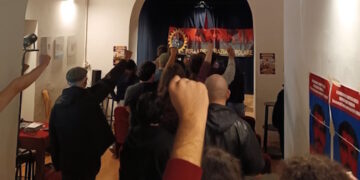

Around 200 people took part in a demonstration on Wednesday (November 4) in downtown Rio de Janeiro, demanding the demarcation of Indigenous lands. Organized by Indigenous organizations, the demonstration marched from Candelária to Cinelândia, calling for the completion of the demarcation of 73 Indigenous Territories and an end to the marco temporal (cutoff-date rule). The International Antiimperialist League (AIL) joined the mobilization alongside popular movements and collectives. At the end of the demonstration, protesters burned the flags of the United States and “Israel” in rejection of Yankee imperialism and the Zionist entity.
Demarcation of 73 Indigenous Territories Brings Indigenous Peoples into the Streets
The 73 territories in question are currently at the declaration stage: their boundaries have already been officially recognized by an ordinance issued by the Ministry of Justice, but the demarcation process still needs to be completed through final ratification.
Participants demanded immediate progress in these processes and rejected the marco temporal, a legal argument that seeks to restrict Indigenous territorial rights to lands occupied on October 5, 1988.
The march followed the route from Candelária to Cinelândia. Upon arrival, Indigenous leaders and representatives of popular movements delivered speeches, raised banners, and presented their demands in front of public buildings.
The demonstration lasted approximately three hours, from 5 p.m. to 8 p.m.

Banner raised by the International Antiimperialist League (AIL). Photo: AND
Attacks on Indigenous Communities Across the Country
“What is happening in Mato Grosso do Sul is no different from what is happening right now on the lands of the Guajajara, in the Maranhão region, and to all Indigenous peoples. This is happening nationwide. The attacks have intensified, the attacks have increased, but agribusiness is present on all these lands.”
The statement by an Indigenous leader present at the demonstration brought together reports of violence from different regions. She also rejected the idea that the election of a government presented as left-wing had put an end to the violence:
“A left-wing government was elected, the left-wing government remained in power, but things will be no different. We cannot let our guard down because the genocide will continue. 526 years after 1500, the genocide continues.”
In Mato Grosso do Sul, APIB denounced murders, vehicle attacks, death threats, and racism following the second round of elections on October 25.
In Tacuru, municipal employees were identified in a conversation in which one of them proposed poisoning the water supply of the Sassoró Indigenous village. The organization also reported incidents in which Indigenous people were run over by vehicles in Coronel Sapucaia.
Days later, Damácio Moraes, a 40-year-old Indigenous man, was found dead in Porto Lindo village, in Japorã, with injuries to his head and neck.
Violence had already affected Indigenous land reclamation movements before the elections. In August, police attacked the Aratikuty land reclamation camp in Dourados. They destroyed Guarani-Kaiowá structures, deployed explosive devices, and fired shots while large landowners and hired gunmen surrounded the area.

Indigenous People Denounce Murders, Poisoning Threats and Intimidation Following Flávio Bolsonaro’s Defeat – A Nova Democracia
The organization also reports incidents of people being run over, death threats and racism. Bolsonaro supporters advocate poisoning water supplies and blocking villages; the violence follows persecution and attacks during the campaign.
In Maranhão, the Guajajara of Santa Maria village, in Grajaú, also face attacks by armed men working for land grabbers and loggers. In March, community representatives went to Brasília to demand the demarcation of their territory and denounce a series of violent attacks that included the burning of 12 houses and a school. The community has been fighting for demarcation for decades.
The situation is reflected in figures from the Indigenous Missionary Council (Cimi): its survey for 2025 recorded 258 murders of Indigenous people in Brazil, 47 more than in 2024. It also recorded 169 conflicts over territorial rights, affecting 143 Indigenous Lands. Delays in demarcation prolong the dispute while communities face invasions and attacks.

Cimi Releases Report in Brasília; Indigenous People Defend Self-Defense and Land Reclamations Against the Reactionary War Waged by the Large Landowners and the Old State – A Nova Democracia
AND covered the event and interviewed Guarani-Kaiowá and Manoki leaders and Cimi’s executive secretary, who denounced attacks on land reclamations and the actions of repressive forces alongside armed gangs serving large landowners; the report records 258 murders of Indigenous people, an increase of 22.3%.
The Struggle for Territory and the Interests of Large Landowners
Demarcation is an immediate demand, but the dispute does not end with administrative procedures. Indigenous peoples defend their territories and their own ways of life against the expansion of large landed estates, land grabbing and major development projects. Poor peasants face these same forces in the struggle for land on which to live and work.
The Ferrogrão (EF-170) exposes this dispute. The railway project between Mato Grosso and Pará was designed to transport grain from large landed estates to northern ports and threatens Indigenous territories and communities along its corridor. It also serves the interests of Chinese social-imperialism: China is the main buyer of Brazilian agribusiness products, and the railway would reduce the cost of transporting soybeans and corn to export ports. Representatives of China Railway Group participated in meetings in 2020 during which the Brazilian government presented Ferrogrão to potential investors. As AND analyzed in its coverage of railway corridors, this infrastructure facilitates the transportation of primary commodities while increasing pressure on territories. Affected peoples denounce the lack of free, prior and informed consultation regarding the impacts of the project.

Rejection of Imperialism
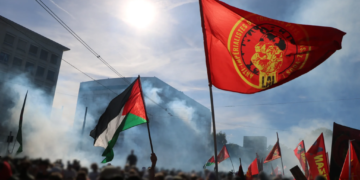
At the end of the demonstration, popular movements and collectives burned the flags of the United States and “Israel”. The act expressed their rejection of Yankee imperialism and the Zionist entity, which is carrying out a genocidal offensive against the Palestinian people with the support of the United States. Participants linked the defense of Indigenous territories to the struggle of peoples against imperialist domination.

Activists burn the flags of the United States and “Israel” at the end of the demonstration in Cinelândia. Photo: AND.
AIL activists also called for a plenary meeting at UERJ on Monday (9), at 6 p.m., on the 8th floor.
The march brought to the streets a demand that cannot wait for the federal government’s timetable: to complete land demarcations and confront attacks by large landowners against Indigenous peoples. In the same struggle for land, the Poor Peasants’ League (LCP) calls on democrats to unite with peasants, Indigenous peoples and quilombolas to defeat the far right, reaction and imperialism. The defense of territories and land reclamations give concrete strength to this unity.