150 People Gather for a Conference in Solidarity with Revolutionary Prisoners in India
On Sunday, October 11, in response to the call of the International Antiimperialist League (AIL), 150 people gathered in Paris for a conference in solidarity with revolutionary prisoners in India.
The conference took place amid the turmoil of the ongoing youth revolt. Despite the exhaustion accumulated over weeks of intense struggle, the AGECA hall was packed with young people, workers, academics and anti-imperialist activists from France, Turkey and India.
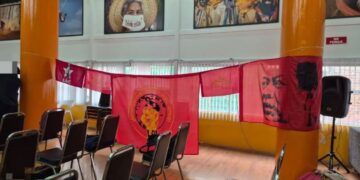
At the entrance to the conference hall, participants stopped to read posters in solidarity with the Jhiram Ghati 10, which had been put up throughout the venue. On September 16, ten Maoist fighters, known as the Jhiram Ghati 10, were sentenced to death by the fascist Indian state. In 2013, they had taken part in a successful guerrilla operation against Indian parliamentarians and police officers in order to defend their Adivasi villages (India’s indigenous populations) against the imperialist interests upheld by the reactionary comprador regime.
Alongside these posters were numerous others expressing solidarity with persecuted Indian activists, including Vijay Kumar Arya, Sabyasachi Goswami, Ashim Mondal, Misir Besra, Sheila Marandi, Pramod Mishra and Sanjay Deepak Rao, as well as tributes to Professor Saibaba, who died shortly after his imprisonment. They were accompanied, of course, by portraits of Ahmad Sa’adat and Alex from Lyon, for whom the Antiimperialist League is also conducting campaigns.
Before the conference began, some very young people were talking among themselves in the audience. One asked, “Do you think they’ll talk about the Maoists?” Another replied, “I hope so. They’re the ones making the revolution in India.” Their wishes would be fulfilled by every speaker, regardless of their perspective or experience of struggle, as each sought to emphasise the importance of the Naxalite and Adivasi struggles in Indian society and the struggle for democracy.
The IAL opened the conference, which featured six speakers in total. The tone was set from the outset. Although the imprisonment of revolutionaries is an odious crime against the peoples, in which imperialists and compradors throughout the world have blood on their hands, we were not there to repeat yet another alarmist and demobilising speech that serves only our enemies.
Above all, the aim was to honour the courage, determination and revolutionary optimism of the prisoners.
“Those who are behind prison walls today fought for the world they believe in,” the AIL explained. “They chose to stand alongside the people and continue to pay the price for it. Prison is therefore not merely a place of confinement. It is also a terrain where the class struggle continues, where state repression comes up against the resistance and revolutionary convictions of political prisoners. And behind this repression lies a reality we must never forget: class hatred!”
The IAL then emphasised the honour of presenting a statement by the next guest, none other than Comrade Ajith, founder and secretary of the Communist Party of India (Marxist-Leninist), once described as “Kerala’s most wanted Maoist” and a former Indian political prisoner.
Before the projector was switched on, someone in the audience told our editorial team: “It’s so good to hear him speak! We campaigned for his release from France a few years ago, and now, thanks to the struggle, he’s free!”
As the room fell into an unusually attentive silence for this kind of event, the comrade’s words resonated. He noted the militancy of Indian youth, encouraged by the recent resignation of the Education Minister following the student revolts of May and June.
“[His resignation] gave a major boost to young people’s confidence that something can be achieved through struggle, and several other struggles have broken out since then and are still continuing. A major struggle is currently underway because the state is trying to exclude a large section of the population from the electoral system.”
Nearly 13% of the electorate has already been excluded, mainly Muslims and Dalits. The comrade also denounced the imprisonment of political and ordinary prisoners awaiting trial, whether revolutionaries or members of the masses, particularly in Chhattisgarh and Jharkhand. He paid tribute to the hundreds of comrades martyred in the struggle for the Indian masses, as well as those imprisoned, some for decades.
Following this exceptional contribution, an Indian activist living in France took the floor. He discussed the intensification of the class struggle in India and the crises affecting the country, which are now also drawing in the urban liberal petty bourgeoisie, whose social position is increasingly threatened and who therefore have every interest in supporting the revolution, even though some still seek to “distance themselves from violence in struggles for social justice.”
He pointed out that even reformists can no longer ignore the violence of state repression. “The Indian state is taking inspiration from the Gaza Strip and Mozambique to oppress Adivasi villages, and little by little, it is intensifying repression everywhere, even in the cities.”
He was followed by Sylvain Goldstein, a CGT activist and former specialist on South and East Asia for the Confederation, who noted that behind its façade of parliamentarism, India has an authoritarian regime.
Under what he described as “bulldozer justice,” the BJP destroys Muslim homes and businesses on the basis of religious discrimination alone.
“For us trade unionists, this issue is essential. Fascism is never merely a question of identity or religion. It is also a social question. Fascism thrives by dividing workers, diverting attention away from the concentration of wealth and economic power. People are repeatedly told: ‘It is not your employer who is responsible for your insecurity, it is migrants, Muslims or minorities.’ This destroys class solidarity.
“That is why the independent trade union movement constitutes an indispensable bulwark. The CGT’s 2023 report highlighted the growing pressure faced by independent organisations in India (…). For the CGT, the position is clear: a trade union is not an instrument of government. It must be free to criticise those in power and employers, to organise workers regardless of religion, caste or origin, and to call strikes.”
Next, a comrade from Partizan, a former political prisoner in Turkey who was arrested in 1998 and participated in the courageous hunger strikes, honoured the conference with his testimony.
He recalled:
“Historically, as well as in the present period, the use of force is indispensable for any change, especially when confronting authoritarian governments that repress their own people, obey imperialist powers and hand over their country’s wealth to them for next to nothing. Revolutionary struggle must necessarily rely on force.”
For all the speakers, it was important to highlight not only solidarity with prisoners, but also their commitment to revolutionary principles, to the “convictions,” as the Partizan comrade described them, which sustain the prisoners and all those who struggle at the risk of their freedom and their lives.
This sincerity and scientific rigour gave the conference an ideological depth that our editorial team is pleased to highlight, drawing a clear line of demarcation from the more “humanitarian” rather than political initiatives concerning political prisoners, to which we have unfortunately become accustomed as activists in France.
The Partizan comrade went on to explain how resistance had been organised inside prisons at all costs, even at the risk of the lives of some imprisoned revolutionaries.
Their persistent refusal to obey led them to endure violence and torture at the hands of their jailers, and so frustrated the government that a minister eventually declared:
“If we do not solve the prison problem, we will not achieve our economic objectives.”
“However,” he noted, “for us revolutionaries, prisons were not only places of detention but also spaces of resistance, collective organisation and political education (…).
“And we were not alone in this struggle. Outside, people supported us, particularly our families. Every week, they demonstrated in support of us and opposed our isolation. Some even went on hunger strike themselves. They were subjected to police custody and arrests.”
The next speakers were Le Cri Rouge, a longstanding organisation in France supporting revolutionary prisoners, and the Communist Youth (JC).
Le Cri Rouge began by saluting the glorious People’s War in India and later honoured the memory of Comrade Basavaraj, killed in May 2025.
They also denounced the capitulationist betrayals of so-called opportunist supporters who call for laying down arms.
“Nevertheless, behind this bleak picture, after six decades of fierce struggle waged by and for the people, one reality stands out. This protracted People’s War, which at its height controlled a third of the Indian subcontinent, continues to be upheld by the CPI (Maoist) and remains ongoing, contradicting the absurd predictions of a Home Minister who claimed he would have eliminated it during 2026.”
Taking up the question of the twists, setbacks and advances that characterise the development of all processes on Earth, and particularly the People’s War in India, the Communist Youth offered an enthusiastic perspective.
“We in the JC believe that Modi and those who succeed him will not be able to implement their genocidal policies so easily if a broad international solidarity movement with India’s revolutionaries is built and developed. This is the best contribution we can make to the Revolution in India.”
While Le Cri Rouge called for “protecting the Party, the United Front and the revolutionary movement,” the JC responded with an optimism matched only by the energy its activists devote to every struggle in which they engage.
“As long as the country’s natural resources are plundered, as long as the forests of Chhattisgarh are devastated, as long as the country’s students are compared to cockroaches, as long as military camps are scattered throughout the countryside, there will be communists, there will be revolutionaries ready to take up arms to defend the popular masses.
“This is not a prediction made by activists seeking reassurance. It is a historical necessity. Water is becoming scarce in India, and global warming is causing unbearable temperatures, sometimes approaching 50 degrees Celsius in certain regions.”
For this generation of French revolutionary activists, currently engaged through their efforts and their very bodies in a militant mass struggle against the French state, the question of humanity’s right to a future is immediately clear, wherever one may be.
In the eyes of our youth, it is evident that this struggle for the future, embodied in the struggle for Revolution, is the only serious struggle for all those who want to live.
For our “children of the crisis,” internationalism comes naturally, even in the heart of imperialist countries, as the conditions facing the international proletariat become increasingly unbearable and its radicalism increasingly necessary.
And so, hearts filled with respect and compassion for our imprisoned comrades nevertheless found room for the joy of struggling together.
Taking up banners in solidarity with political prisoners in India, as well as with the People’s Wars in Turkey and the Philippines, participants chanted slogans such as “Lal Salaam, Lal Salaam,” “Inquilab Zindabad” and “People’s War Until Communism.”
Before departing, one final resolution was adopted: to establish committees in support of the Indian people.
The AIL declared:
“We call on all revolutionary activists, internationalists and sincere democrats to intensify solidarity with the working class, peasantry and oppressed masses in India, and particularly with those who are fighting with arms in hand.”
The conference participants then parted ways, arranging to meet again at the blockades and demonstrations planned for the coming week.
This conference was therefore a great victory for sincere anti-imperialists. Why? Because it brought together revolutionaries from three countries: France, Turkey and, of course, India.
It upheld a clear ideological and political line: perseverance in the People’s War, a perseverance nourished by the remarkable vitality of the Indian masses.
Confronted with fascism and Hindutva, these masses struggle every day through powerful movements.
Perseverance along the path of People’s War also means struggling against liquidationism and capitulation, which today find expression in the line promoted by the traitors Sonu-Devij-Balraj, these “new” revisionists who draw upon the shameful experiences of the Prachandas in Nepal and the Myriams in Peru.
They have caused serious damage to the Party and the Revolution. But Marxism has taught us that the masses make everything, that they are capable of anything, and that the proletariat never suffers definitive defeats, only temporary detours, however long they may be.
This conference also demonstrates a reality: the Antiimperialist League is today the sole centre of active solidarity with the People’s War in India.
A centre capable of coordinating mobilising and militant initiatives across all continents in support of the line of the New Democratic Revolution.
The establishment of solidarity committees with the masses in India will undoubtedly mark a step forward in supporting both the vigorous struggle of the Indian masses and their fighting vanguard, the CPI (Maoist).
The participation of 150 people, the overwhelming majority of whom were young, particularly those involved in the recent revolts taking place in France, is no coincidence either.
The development of the class struggle in the imperialist centres reflects an era of great change. An entire generation is taking the path of Maoism — that is, the path of the Marxism of our time — and therefore of violent revolution to break capitalist terror.
The example of the Revolution in India in its current phase will educate these thousands of young communists, both in perseverance along the line of People’s War and in the relentless struggle, the struggle to the death against revisionism, the principal obstacle and principal enemy of the revolution in France and throughout the world.