Report of the National Campaign “Lyon: Capital of the Resistance”

On May 8, 2026, to mark the Day of the Victory of Communism over Nazi barbarism, the revolutionary youth of France, at the initiative of the Communist Youth, carried out a large-scale agitation campaign in the heart of Lyon. The slogan for this campaign was: “Lyon, Capital of the Resistance.” Here is our report on the event.
The day began at 7 a.m. in a park located in the suburbs of Lyon. In the morning chill, more than a hundred activists were busy preparing for the day. Among them were students, workers, the unemployed, and high school students, who had come from all corners of the country. Until late afternoon, this group of about a hundred young people will traverse the entire city of Lyon. 40,000 leaflets were distributed, 250 posters put up, and 60 banners hung to carry out the “Lyon, Capital of the Resistance” campaign.
The organizing committee outlined the day’s objectives. Lyon, now regarded as the French capital of fascism, must be the scene of a day of counter-demonstrations. It is unacceptable that this city, which was once the heart of the domestic Resistance against fascism, should become, in the eyes of all, a playground for neo-Nazi splinter groups. Furthermore, this operation must mark the beginning of a major campaign against the trend toward fascism and reactionary forces, which must by no means wait for the electoral circus to unfold as widely and deeply as possible within the masses in France.
So, first thing in the morning, activists were deployed across the city. In Vénissieux, Saint-Priest, and Vaulx-en-Velin, flyers were distributed in front of major shopping centers and in nearby mailboxes. Student housing near Lyon 2 Bron University was also visited. At Part-Dieu Station, the revolutionary youth chose a symbolic approach. Following the example of the communist Resistance fighter Fabien, the activists distributed leaflets as trains pulled into the station. Across the avenue, an impressive leafleting took place right in the middle of the Part-Dieu shopping center, right under the noses of security, which caught the attention of passersby below.
At Confluence, a similar leafleting took place in the shopping center. Once the comrades came back down, security immediately stopped and assaulted them. A disproportionate reaction to a completely peaceful and democratic action, but one that follows the ongoing trend of reactionnarization. This attempt at intimidation did not deter the combative young people, who resumed their activity as soon as they were free of security.
Several monuments dedicated to the Resistance were also visited and honored by the various activist groups. In Croix-Rousse, young people honored the memory of the Canuts, iconic figures in the history of the class struggle in Lyon. Primarily based in the Croix-Rousse neighborhood—which is currently undergoing rapid gentrification—the Canuts represented the vanguard of the working class in France in the early 19th century. Between 1831 and 1849, the Canuts revolted four times against the poverty imposed by the bourgeoisie. Under the slogan “Live by working or die fighting,” the Canuts embodied the necessary revolt against injustice, which the young activists were quick to honor.
Lyon has no shortage of monuments honoring the martyrs of the Resistance, and it was primarily they who were honored that day. Under both the Vichy regime and direct Nazi occupation, the city served as the nerve center of the armed anti-fascist resistance, including the Communist resistance. Great names adorn the city’s walls and statues, but above all, its popular memory. Léon Landini, Berty Albrecht, Jean Zay, Gilbert Dru, Charles Delestraint, René Leynaud, and of course Jean Moulin. Yet this memory is a battleground between the bourgeoisie and the proletariat. Three years ago, Emmanuel Macron traveled to Lyon to “honor” the memory of the Lyon Resistance fighters while the police fired tear gas at the May 8th union commemoration rally. The following year, Missak Manouchian was interred at the Panthéon, initially without the presence of his former comrades-in-arms from the FTP-MOI and in the presence of National Rally (RN) officials. It was this shameless attempt to whitewash history that was denounced by the activists, who, in their various speeches, made it clear that our class rose up and was the only one to rise to the occasion, despite the torture, deprivation, deportations, and executions.
Thus, banners paying tribute and red roses were laid at the foot of the statue of Jean Moulin in Caluire-et-Cuire, in front of Fort Montluc—a stronghold of torture orchestrated by the Gestapo and collaborators under Klaus Barbie—as well as on the Place des Martyrs de la Résistance. In front of the statue of the Internal Resistance in Bellecour, activists also placed a flag bearing the hammer and sickle.
After a short lunch break, the operation resumed for the rest of the afternoon. By bike, car, on foot, or via public transit, the city continued to be crisscrossed until 5 p.m. The large working-class neighborhoods within Lyon’s city limits, such as Mermoz, Paul Santy, and États-Unis, saw their walls adorned with posters of major communist figures of the Resistance—such as Colonel Fabien, Guy Môquet, and Danielle Casanova—as well as posters for the operation, banners, and messages of support for the agrarian revolution in Brazil. Outside Lyon itself, working-class neighborhoods in Vénissieux—particularly several areas of the Minguettes and Parilly districts—as well as Saint-Priest, Bron, and Villeurbanne were also visited. The activists took to the streets in the markets of the districts and working-class neighborhoods, engaging with residents about the content of the leaflet and the highly political significance of May 8. In some groups, activists did not hesitate to enter bars and restaurants to talk with customers.
Notably, numerous banners displayed throughout Lyon’s districts expressed the solidarity of France’s militant youth with the anti-fascists currently imprisoned in connection with the Deranque case. This was an inevitable show of solidarity on a day of anti-fascist mobilization, when the bourgeoisie is trying at all costs to isolate the activists—all the more so when they are imprisoned and a portion of the progressive camp has turned its back on them.
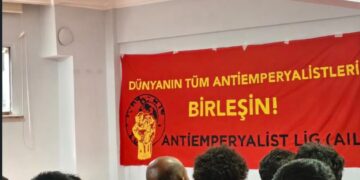
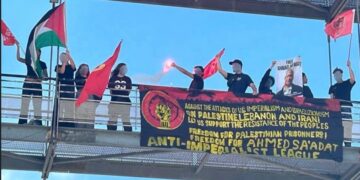
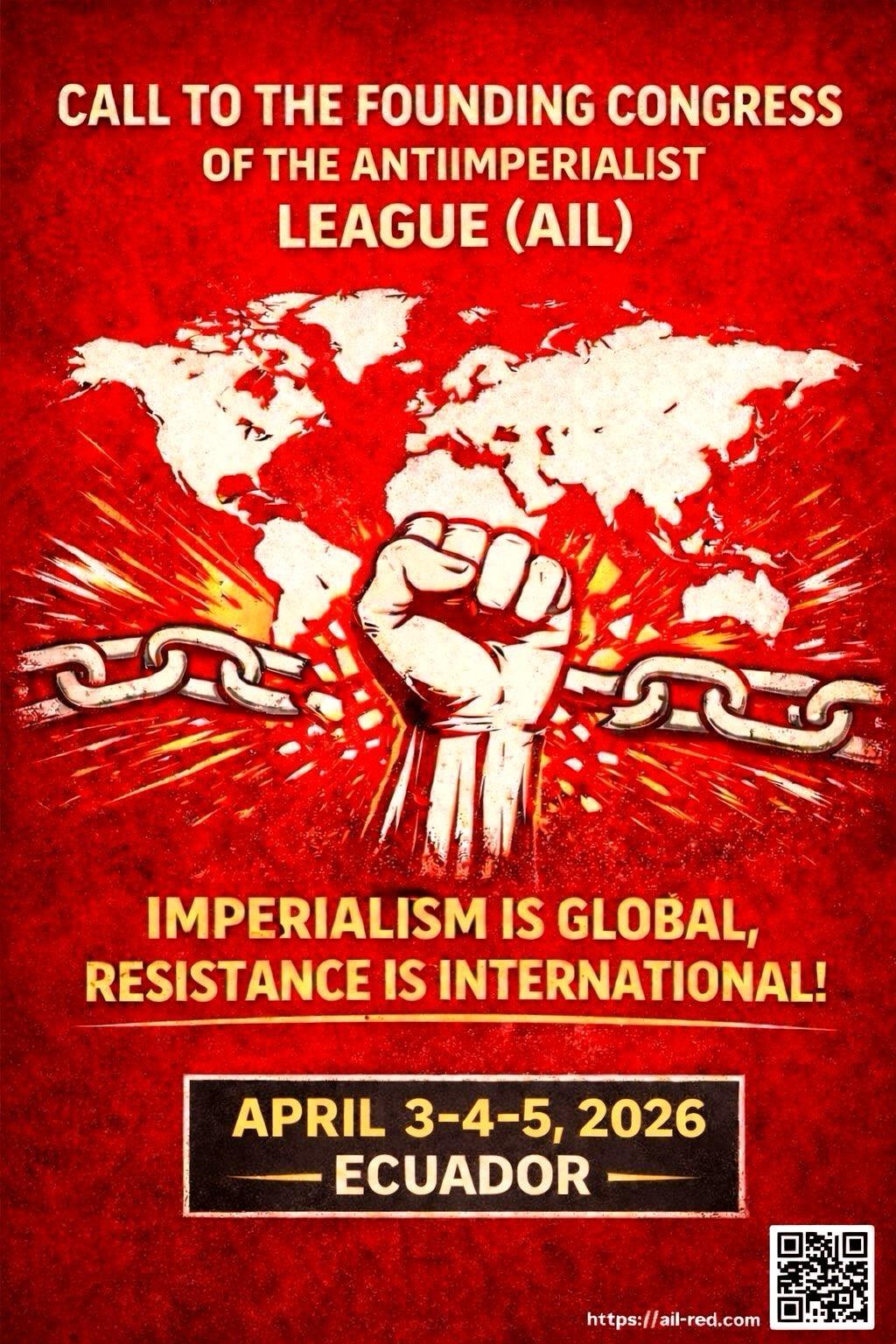
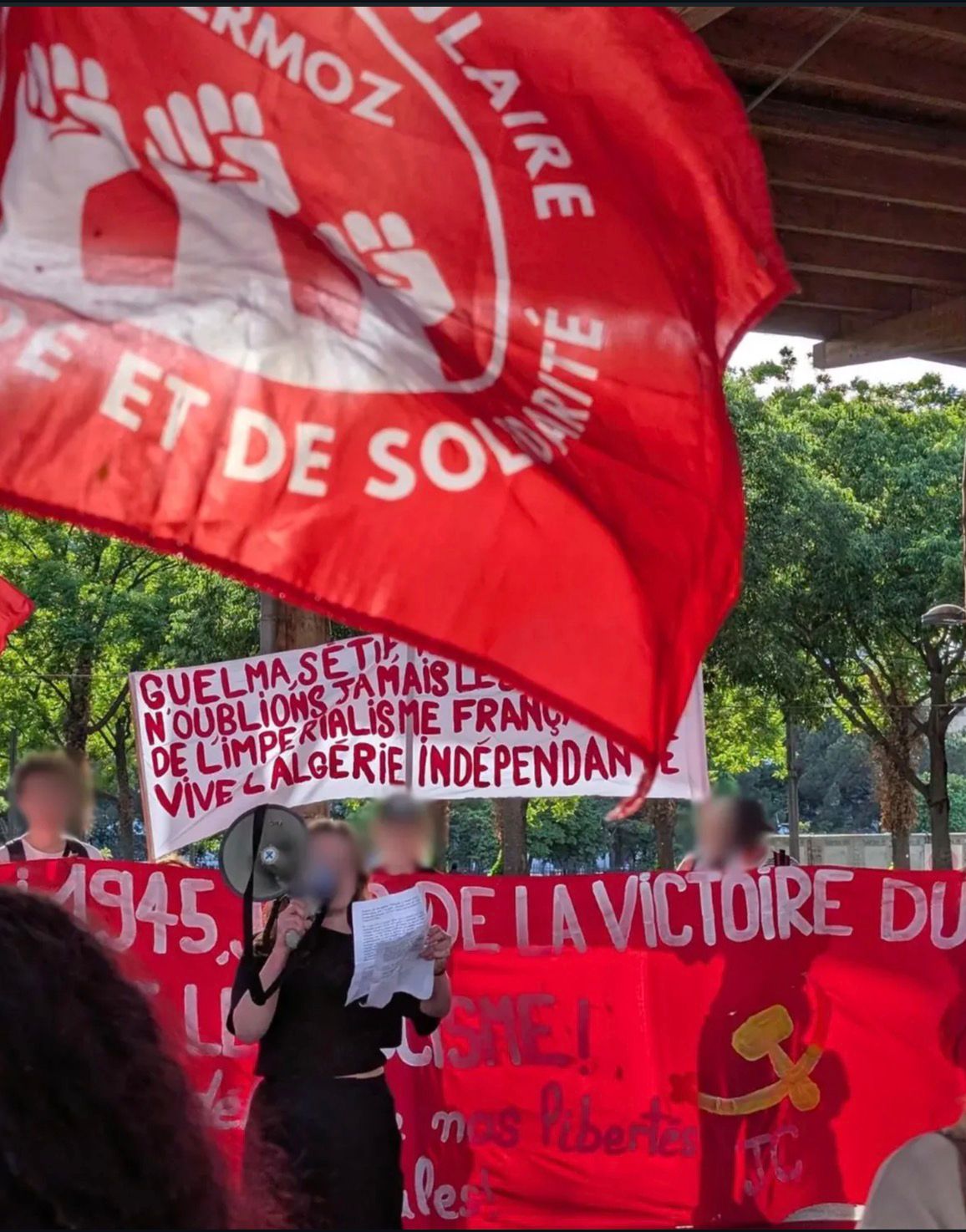
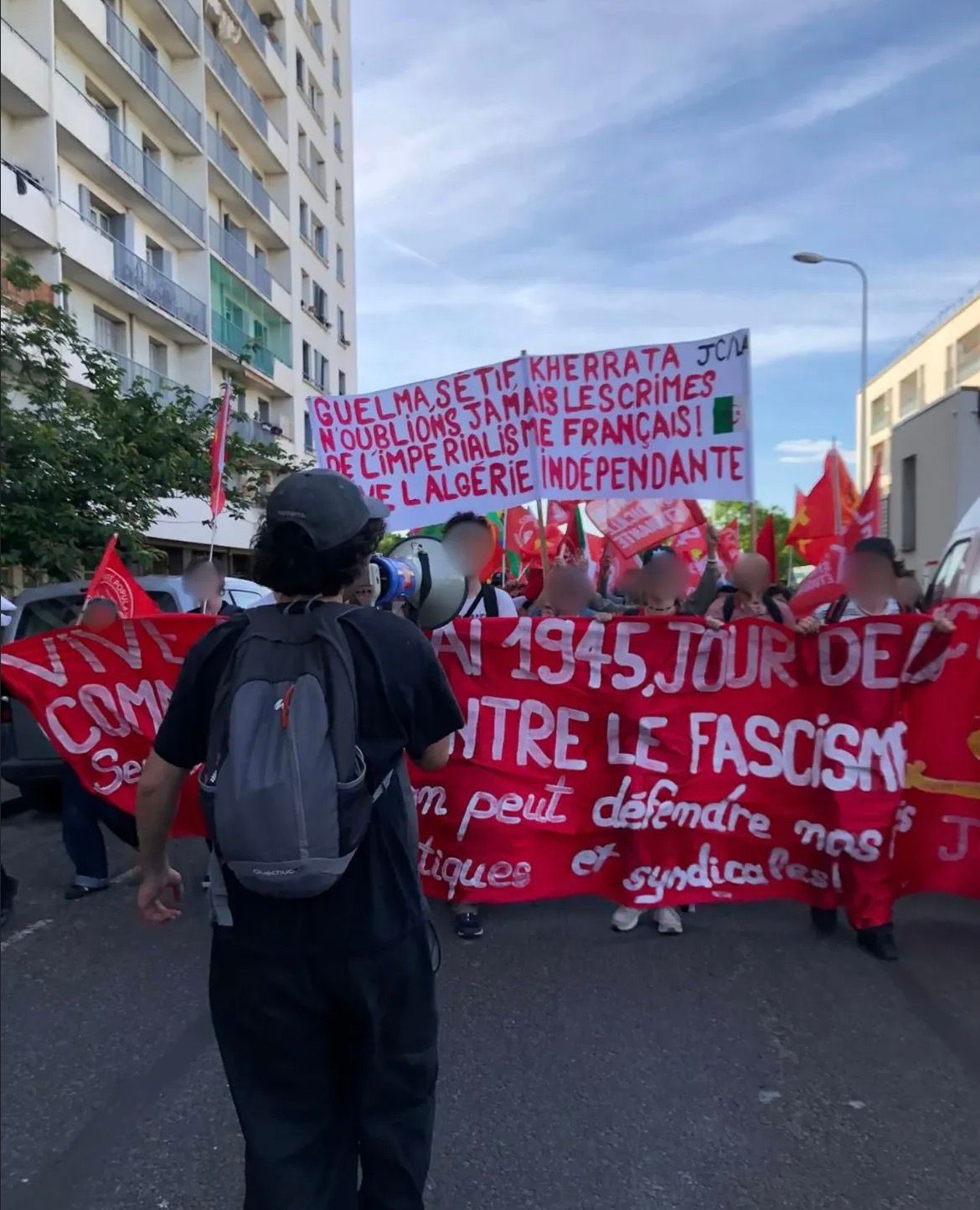
But this day was not merely a day of commemoration of the victory of the national antifascist Resistance. In the same areas mentioned above, banners commemorating the massacres of Sétif, Guelma, and Kherrata in Algeria on May 8, 1945—massacres committed by colonial France—were displayed to underscore the dual nature of this day. On the one hand, the youth were determined to commemorate the sacrifice of tens of thousands of sons and daughters of the French proletariat, who took up arms to repel fascist barbarism. But on the other hand, they do not forget the massacres committed by French imperialism, which, in taking back control of affairs at the end of the war, decided as its first act to apply the fascist methods and massacres that it had itself suffered during the Occupation. In a necessary anti-imperialist spirit—for the struggle against fascism is not an exclusively national cause—commemorating the barbarity of the French bourgeoisie and the heroism of the people in the same breath is a major political and historical necessity. It is also in this spirit that several banners of the Anti-Imperialist League were seen in various parts of the city, celebrating the organization’s World Congress.
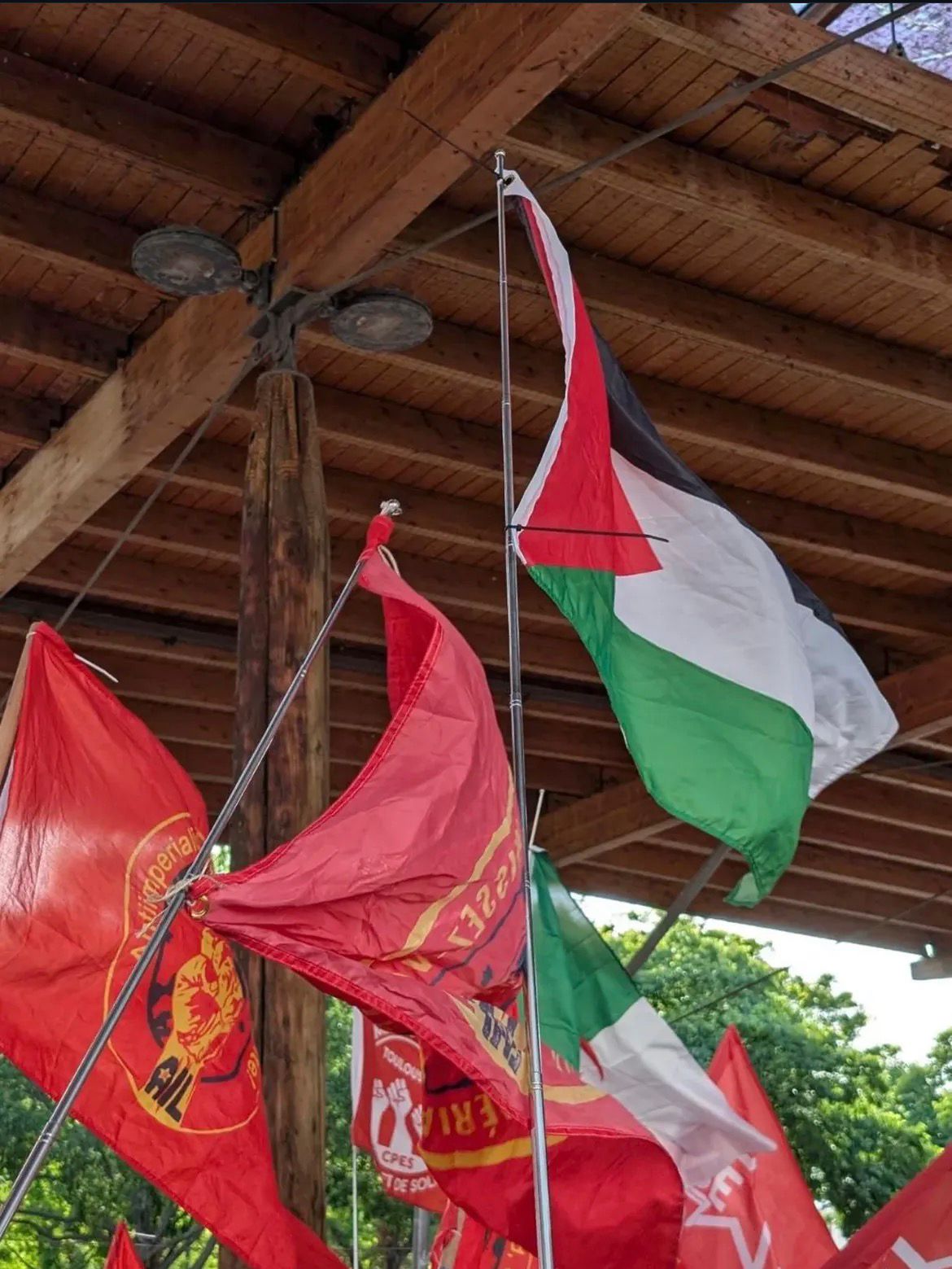
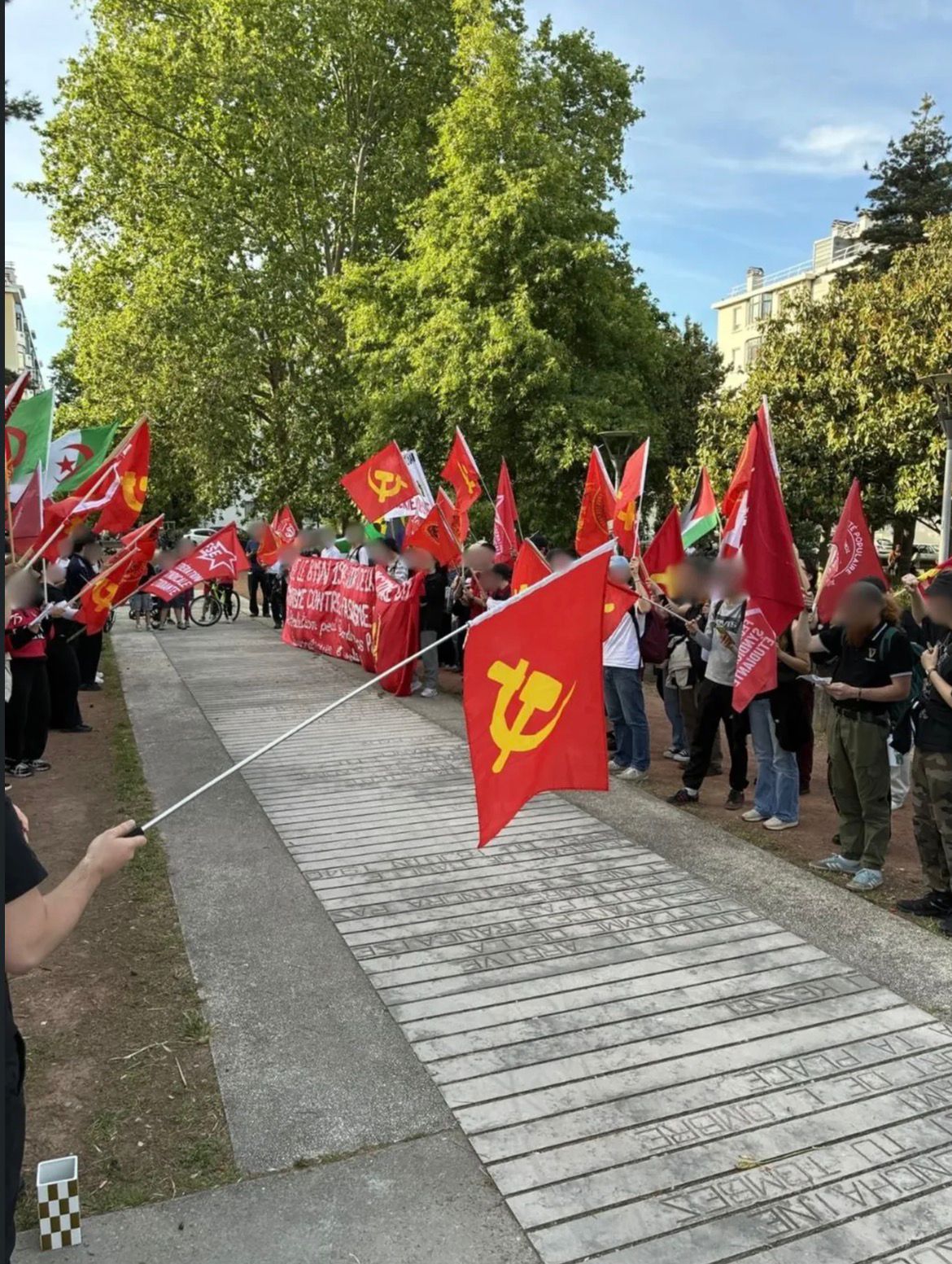
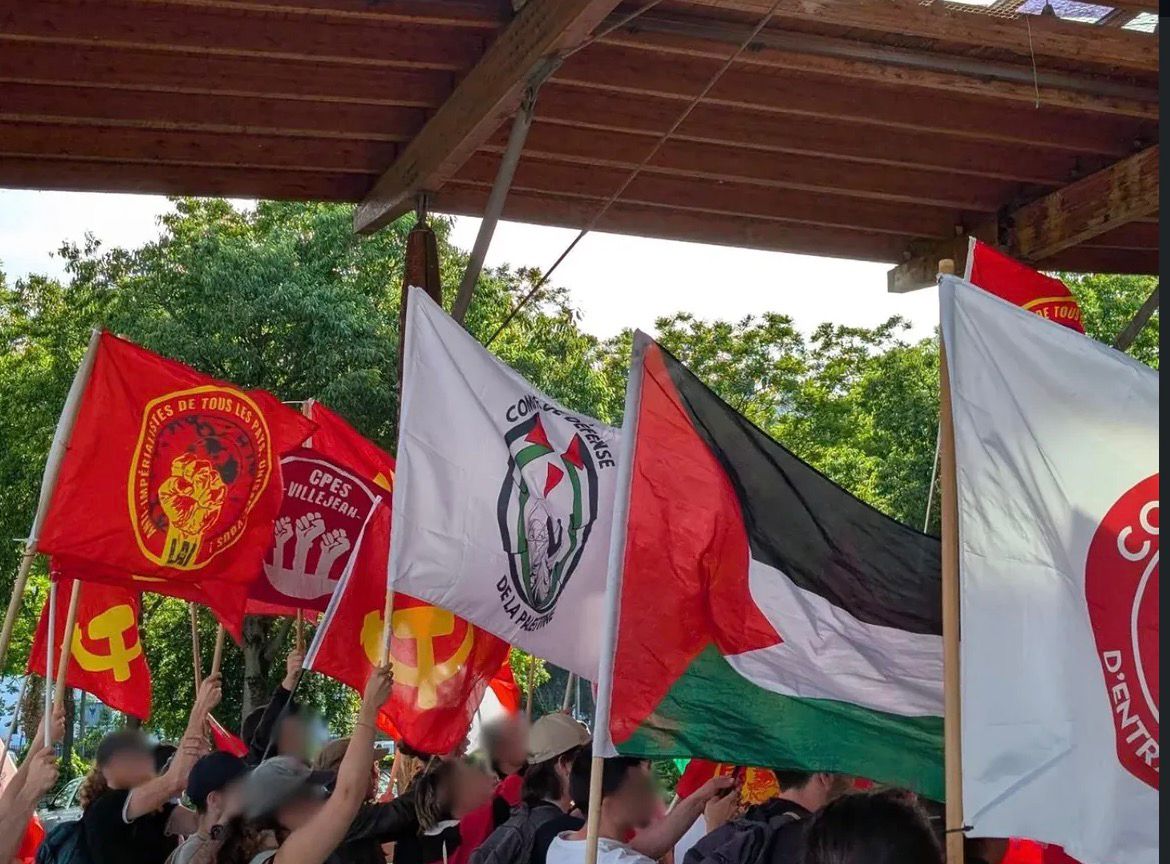
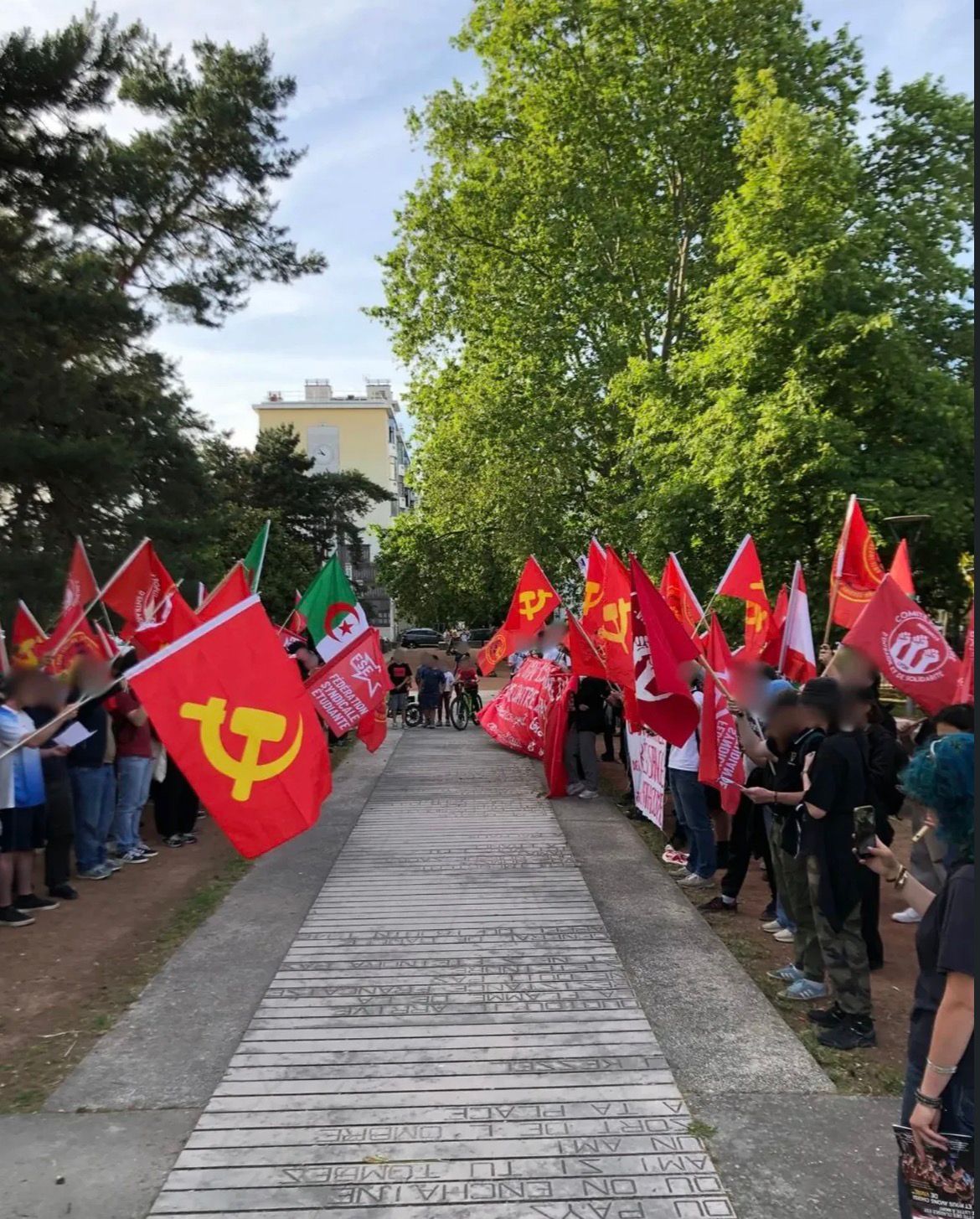
Once all the areas had been visited, the various groups converged in the 8th arrondissement for the May 8 commemoration rally, organized jointly by the Communist Youth and the Popular Committee for Mutual Aid and Solidarity of the États-Unis neighborhood, bringing together more than 175 people.
What can we take away from this day? First, that the revolutionary youth remain determined to defend the memory and the gains of the anti-fascist Resistance, won through the sacrifices of the resisters and communists, even in the supposed strongholds of the fascists. While they claim everywhere that the city is fascist, more than a hundred people have proven the opposite. More broadly speaking, the reactionary bourgeoisie constantly tries everywhere to make people believe that the majority of the French population shares their views. On this day, nothing could be further from the truth, as a large portion of the masses encountered during the operation welcomed the mobilization with interest and approval, right in the midst of growing reactionary tendencies. The anti-fascism of our time must be a tool for mobilizing and organizing the masses, in all sectors of their lives, in working-class neighborhoods, in workplaces and public spaces, and on college campuses. Without the combative mobilization of the masses, we will always remain vulnerable both to the rise of reaction and to the fascists. This mobilization cannot happen without grassroots work on the ground in every city and village in France, without breaking out of the activist milieu that is too distant from the masses. This operation is the starting point for a broad campaign to defend democratic and union rights, which cannot be resolved by legitimizing the current political regime. Today’s anti-fascism will be built with the masses, in the fiery heat of the class struggle, by shattering the electoral consensus—or it will not be built at all. Lyon has been, is, and will forever remain the capital of the Resistance!
Source information:https://www.causedupeuple.net/2026/05/09/retour-sur-loperation-nationale-lyon-capitale-de-la-resistance/